
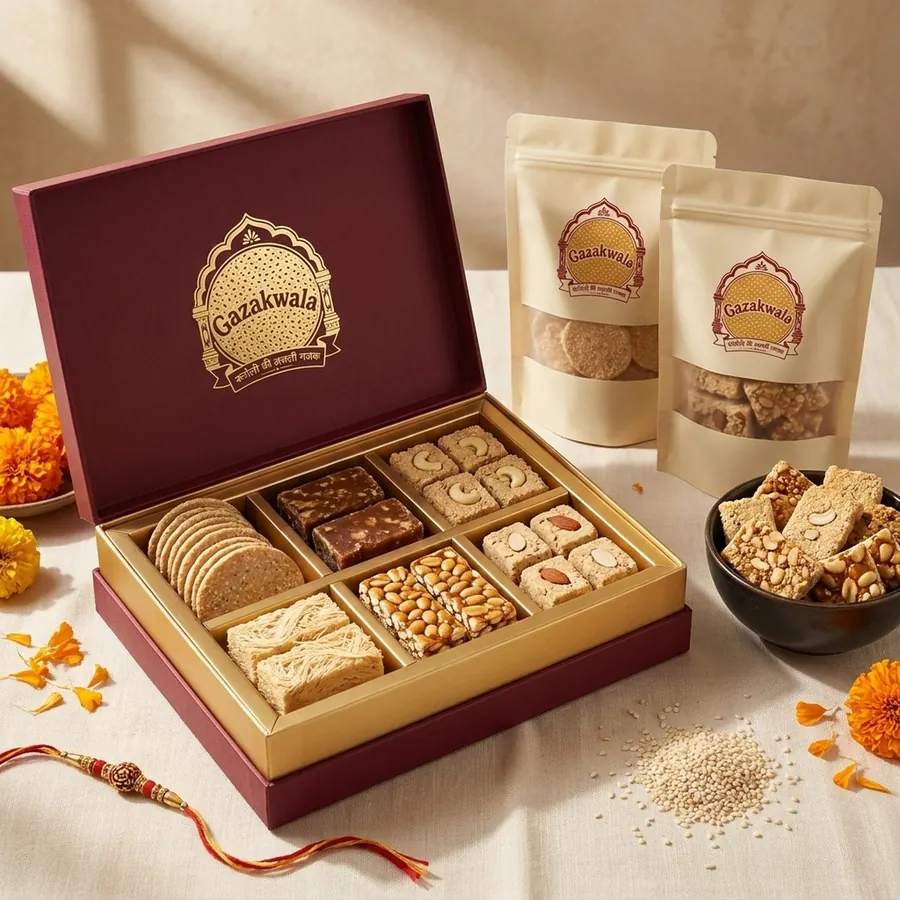
A wholesale buyer's practical guide to sourcing gajak: what the grades really mean, which packing survives a courier, and why December is too late for January delivery.
The grades and what actually separates them
A bulk buyer talking to a gajak manufacturer will hear seven or eight names. They are not different sweets; they are different grades and formats within the same family, and each has its own buyer.
- Gud gajak — pure jaggery, roasted til, dense slab. The traditional flagship, popular with older buyers and Rajasthani households. Mid-price band.
- Khasta gajak — beaten longer for a lighter, layered bite. Popular in North Indian gifting boxes. Slightly higher labour cost than gud gajak.
- Chini gajak — sugar-based rather than jaggery. Paler, sweeter, more child-friendly. Usually the cheapest grade because sugar is cheaper and simpler to work than gud.
- Dry-fruit gajak — cashew, almond or pistachio folded into the slab. Premium band, driven mostly by the cost of the nut.
- Khoya gajak — reduced milk solids folded in for a softer, richer piece. Short shelf life, higher price, gifting-only.
- Tilpatti — the paper-thin disc form. Labour-intensive to roll well and pack. Premium band on a per-kg basis; the format most people want in a corporate box.
- Revdi — small coated droplets, mostly loose sweet for Lohri distribution. Long shelf life, lowest price per kg.
Sesame quality: what to actually ask for
Sesame is the input that decides whether the finished gajak snaps sweetly or tastes flat. There are two families of til in the market — hulled (white, plump, cleaner) and unhulled (natural, slightly bitter, higher fibre). Almost all quality gajak is made with hulled white til.
Beyond hulling, three specifications matter. Moisture content — below 6% is standard for sortex-graded til; higher moisture leads to soggy slabs. Sortex grading — mechanical colour sorting removes off-colour seeds and stones and is the difference between kitchen-grade and export-grade sesame. Seed size — plump, uniform seed roasts evenly; a mixed size batch will have some seeds burnt while others are still raw.
A serious supplier will be able to send a spec sheet with these numbers. Ask for it.
Jaggery quality: gud is not gud
Jaggery grade decides both the colour of the finished slab and the shelf life. Cheap dark jaggery is often chemically treated to lift its colour and can carry a metallic aftertaste that survives the cooking. Good quality gud is naturally light-brown, breaks cleanly, and smells of cane rather than of anything else.
For bulk gajak the practical test is simple: ask what grade of gud goes into the slab and where it comes from. Karauli-region gajak makers typically source gud from the neighbouring sugarcane belts of Uttar Pradesh and eastern Rajasthan; that traceability is a reasonable signal.
Why gajak is the hardest sweet to ship, and what actually works
Gajak is laminated air-and-sugar; that is what makes it eat beautifully and travel badly. A slab that survives an unrough journey will still lose a fraction to edge chipping. A slab that meets a rough journey in bad packing arrives as sesame gravel.
Packing that actually holds up has four elements. A rigid inner tray, sized to the piece so it cannot shuffle. Individual food-grade wrap on each slab, so pieces do not grind each other. Void-fill (paper shred or moulded pulp) around the tray, so the tray itself does not slide inside the outer. And an outer carton stiff enough that fingertip pressure on the corner does not deform it.
Loose bulk cartons — pieces stacked in a plain corrugated box — save 8–10% on packing cost and lose 30–40% of the pieces to breakage in transit. It is a false economy. Any serious wholesale supplier should be able to show you their inner-pack format before you commit.
Shelf life, stated honestly
This is where a lot of category marketing gets loose, so it is worth being specific.
Gajak and tilpatti are hygroscopic. In sealed packaging, stored below 25°C and away from humidity, good gajak is at peak crispness for around 3–4 weeks from date of manufacture and eats acceptably for up to 8 weeks. It does not go dangerously off within that window; it goes soft. Softness is a quality problem, not a safety one.
Any supplier claiming a six-month crisp shelf life for gajak without preservatives is either using a different definition of crisp or a different definition of gajak. Chikki and revdi keep longer — 6–8 weeks — because they are denser and less layered.
For a corporate gifting run planned four weeks before dispatch, this shelf-life reality is important. It is why fresh production close to the delivery date matters, and why summer bulk gajak orders are a bad idea.
The seasonal reality
Gajak production is seasonal because the craft is seasonal. The beating and folding step requires the mass to cool at a controllable rate; in Indian summer heat, the mass stays workable for too long and the layers slump. Traditional units run production from roughly October to late January.
For a buyer, this means capacity is finite and it fills in an order that has almost nothing to do with when your finance team signs off the budget. Here is how a corporate buyer should plan against it.
| Month | What a bulk buyer should be doing |
|---|---|
| August | Scoping suppliers, requesting samples, agreeing formats. |
| September | Firming quantities. Suppliers open their winter production books. |
| October | Confirmed orders with deposits. Custom branding signed off. Production plans locked. |
| November | Production runs. Late-arriving buyers can still get standard formats if capacity remains. |
| Early December | Practically the cut-off for large custom-branded runs for January delivery. |
| Late December | Small top-up orders only. Fresh season stock is being reserved for existing clients. |
| January | Delivery month. Buyers who confirmed in Aug–Oct get what they ordered; walk-ins get what is left. |
Documentation and labelling checklist
A serious wholesale buyer should ask a supplier for the following, and a serious supplier should have it ready without hesitation.
- FSSAI licence number, visible on every pack.
- Product spec sheet — ingredients, allergen declaration, nutritional information.
- Batch code and manufacturing date on every unit, not just the outer.
- Allergen call-outs on pack: sesame is a declarable allergen; so are tree nuts if the SKU contains them.
- Net weight, veg mark, and manufacturer address as required by FSS labelling rules.
- If you are private-labelling, agreement on who is the FBO on the pack and whose licence prints on it.
MOQ, lead time and private label
For our own bulk work, standard SKUs (250 g, 500 g, 1 kg boxes in existing formats) start at a modest MOQ and can typically be dispatched within 7–10 days during production season. Custom-branded outer sleeves add 2–3 weeks of design, proof and print time on top of the production window, which is why an October confirmation is the honest cut-off for a January delivery run.
Private label — your brand on our pack — is available. Full custom hampers combining gajak with other festival items go through our sister brand GiftingAdda, which handles the assembly work.
Ready to talk numbers
For MOQ, current wholesale pricing bands and a sample dispatch, use the bulk enquiry form on our wholesale page. We answer within a working day.
Frequently asked
- What is your MOQ for bulk gajak orders?
- Standard SKUs (250 g, 500 g, 1 kg boxes) start at a modest MOQ and can be dispatched in 7–10 days during production season. Please use the bulk enquiry form on our wholesale page for current numbers.
- How early should I place a corporate Sankranti order?
- By late September to October for confirmed pricing and slot. December enquiries for January delivery usually get whatever standard stock is left; custom-branded runs are practically impossible after early December.
- Can you do custom-branded boxes?
- Yes. Private label with your branding on our pack is available, subject to design lead time (2–3 weeks) on top of production. For fully custom hampers combining gajak with other items, we route the assembly through our sister brand GiftingAdda.
- How long does bulk gajak keep?
- Sealed and stored below 25°C, gajak and tilpatti are at peak crispness for 3–4 weeks and eat acceptably for up to 8 weeks. We do not claim longer shelf life because we do not use preservatives.
संक्षेप में (हिंदी)
थोक में गजक खरीदते समय ग्रेड को समझना ज़रूरी है — गुड़ गजक, खस्ता, चीनी, ड्राई-फ्रूट, खोया, तिलपट्टी और रेवड़ी सबकी अलग कीमत और अलग खरीदार होते हैं। तिल और गुड़ की गुणवत्ता — विशेषकर सोर्टेक्स-ग्रेडेड सफ़ेद तिल और साफ़ भूरा गुड़ — तैयार माल की गुणवत्ता तय करते हैं।
गजक नाज़ुक होती है — सख्त इनर ट्रे, हर टुकड़े पर अलग रैप, चारों तरफ फिलिंग और मज़बूत बाहरी डिब्बा — इस पैकिंग के बिना बल्क शिपमेंट में 30–40% तक टूट-फूट सामान्य है।
गजक सीज़नल है — अच्छी उत्पादन क्षमता अक्टूबर से जनवरी के बीच होती है। जनवरी में डिलीवरी चाहने वाले कॉर्पोरेट खरीदार को अगस्त–अक्टूबर तक ऑर्डर पक्का करना होता है। दिसंबर में फोन करने वालों को अक्सर वही मिलता है जो बचा रहता है।
करौली की असली गजक — सीधे आपके घर तक
Order our winter batch on WhatsApp. Small-batch, no palm oil, no preservatives.
Order on WhatsApp