
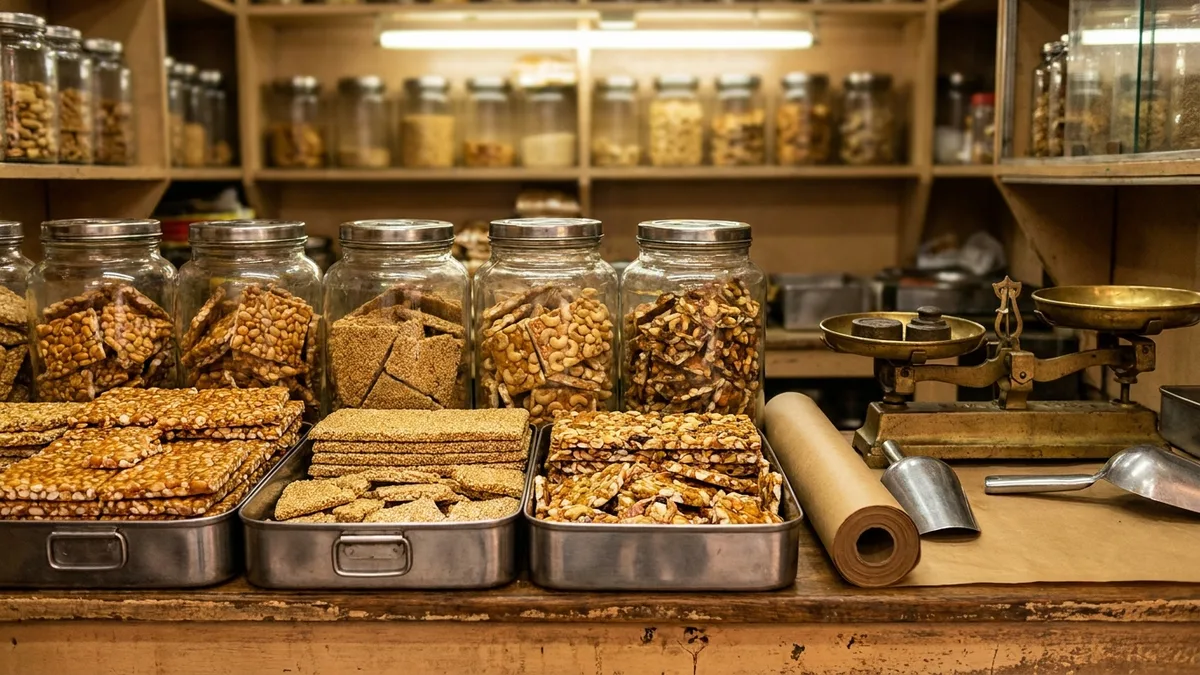
Four things decide what a chikki costs, and three of them are invisible until you break a piece open. Here is how the pricing actually works.
Roughly what the market looks like
Plain peanut or groundnut chikki, bought as loose weight from wholesale and trade listings, broadly clusters between ₹150 and ₹290 per kilo. The spread inside that band is mostly nut ratio and packing — the low end is a jaggery-heavy bar sold unpackaged, the high end is a nut-dense one in a printed pouch.
Branded retail and D2C packs sit materially above that, and legitimately so. Once you add 250 g or 500 g packaging that survives transit, a brand's overheads and margin, and shipping across the country, the per-kilo cost structure is a different exercise from a counter sale at a wholesale market.
Dry fruit, kaju and badam chikki price well above plain peanut, and the reason is uninteresting but decisive: the nut is most of the cost, and cashew and almond cost several times what groundnut costs per kilo. There is no clever manufacturing route around that.
Prices quoted here are indicative market ranges as of August 2026, gathered from public trade listings. They are not our price list — confirm current rates directly.
The four things that actually move the price
Two bars that look identical on a shelf can differ by two or three times in cost to make. Here is where that difference sits.
- The nut. Cashew and almond run several times the per-kilo cost of groundnut, and pistachio higher still. In a bar that is more than half nut by weight, nut choice dominates everything else in the cost sheet — which is why peanut chikki is cheap and dry fruit chikki is not.
- Jaggery grade. Clean, naturally pale gud made without chemical clarifiers costs more than cheap dark jaggery, and the difference is obvious on the tongue — good gud tastes mineral and round, poor gud tastes flat and slightly sour. This is the input most cheaply downgraded because buyers rarely think to blame the jaggery.
- Nut-to-jaggery ratio. A bar that is mostly jaggery with nuts scattered through it is far cheaper to make and eats thin and cloying. This is the single most common way inexpensive chikki disappoints, and it is invisible from the outside of a pack.
- Packaging and channel. A loose kilo off a counter, a 400 g printed box on a shelf, and a shipped D2C pack with protective packing are three genuinely different cost structures for the same sweet. Shipping brittle sweets intact is not a trivial line item.
Why the cheapest chikki is usually a jaggery bar with a few nuts in it
Run the arithmetic. If groundnut costs meaningfully more per kilo than jaggery — and it does — then every percentage point of nut you replace with jaggery lowers the cost of the finished bar. A maker competing purely on price has one lever that works, and that is the lever.
The result is a bar that is technically still peanut chikki. It has peanuts in it. But the nut sits sparsely in a thick jaggery matrix, so what you actually taste is sweetness, and what you feel is a hard sugar slab rather than a nut bar. It is also why cheap chikki tends to be thicker: jaggery is the cheap filler, so the maker has no reason to roll it thin.
You can spot it in two seconds if you can see a broken edge. Look at the cross-section. In a good bar the nuts are packed shoulder to shoulder with jaggery only filling the gaps between them; in a cheap one you see continuous jaggery with nuts floating in it. Ask for a broken piece at a counter, and on a D2C site look at whether the product photography shows a cross-section at all — brands confident about their ratio show it.
Wholesale vs retail vs D2C
There is no single right channel — each is priced for a different job. Match the channel to what you actually need.
| Channel | What you are paying for | When it makes sense |
|---|---|---|
| Loose from a local counter | The sweet and nothing else — no packaging, no brand, no transit | You live near a good maker and will eat it within a week |
| Branded retail pack | Consistency, labelling, shelf availability, retailer margin | You want a known product on demand and can inspect the pack |
| D2C shipped pack | Freshness from the source, protective packing, courier, traceable batch | You are not near a maker, or you want a specific region's product |
| Bulk / corporate | Volume rate, custom packing and branding, scheduled dispatch | Gifting runs, resale, or repeat institutional orders |
Seasonality
Chikki and gajak are winter-production sweets. The craft is built around cool, dry air — jaggery behaves predictably at lower temperatures and the finished slab holds its snap instead of going tacky within the hour. Production peaks from roughly October through February, and that is when the freshest stock exists.
The inputs swing too. Jaggery is cheapest and best right after the sugarcane crushing season gets going, and groundnut prices move with the kharif harvest arriving in the market. Both cycles land in the same broad part of the year, which is not a coincidence — the sweet developed around the availability of its ingredients.
One honest caveat on the buying advice: purchasing in peak season usually gets you fresher stock rather than a lower price, because that is also when demand is highest. Buy in season for quality, not for a discount.
Prices quoted here are indicative market ranges as of August 2026, gathered from public trade listings. They are not our price list — confirm current rates directly.
How to judge a pack before you buy
Six checks, none of which take longer than a few seconds, and together they separate a bar worth its price from one that is not.
- Look at the cross-section for nut density — nuts packed close with jaggery filling the gaps, not nuts floating in a jaggery slab.
- Check the jaggery: a clean amber-to-dark tone and a warm caramel-mineral smell. A sharply sour or chemical note means poor gud.
- Check the manufacturing date, not just the expiry. Chikki is a fresh-eating sweet and a bar made five months ago is legally fine and texturally past its best.
- Read for glucose syrup and palm oil in the ingredients. Neither belongs in traditionally made chikki; both are there to cut cost or soften the bar.
- Find the FSSAI licence number on the pack. Its absence on a packaged food is a reason to walk away.
- If it is being shipped, ask how it is packed. Badly packed chikki arrives as fragments, and no amount of quality upstream survives a loose box.
Buying from us
Gazakwala makes chikki and gazak near Karauli in Rajasthan, under FSSAI Lic. No. 12224038000012, and ships pan-India. We work to a nut-heavy ratio and pale, clean jaggery, and we pack for transit rather than for the shelf, because most of what we send goes by courier.
Current pack sizes and prices are confirmed on WhatsApp before dispatch, so you know the rate and the packing before anything ships. For gifting runs, corporate orders and resale volumes, the bulk page sets out how the rates and custom packing work.
Frequently asked
- How much does peanut chikki cost per kg?
- Wholesale and trade listings for plain peanut chikki broadly cluster between ₹150 and ₹290 per kg depending on nut ratio and packing. Branded retail and shipped D2C packs sit above that once packaging, brand margin and courier costs are included. These are indicative August 2026 ranges, not a price list.
- Why is dry fruit chikki so expensive?
- Because the nut is most of the cost, and cashew, almond and pistachio run several times the per-kilo price of groundnut. In a bar that is more than half nut by weight, the nut choice sets the price and there is no way to manufacture around it.
- Is cheaper chikki lower quality?
- Usually it is a ratio question rather than a quality failure. Cheap chikki is typically made with less nut and more jaggery, which is legitimate but eats thin and cloying. Poor jaggery and added glucose syrup are the genuine quality problems, and both tend to show up at the bottom of the price range.
- Is it cheaper to buy chikki in bulk?
- Per kilo, yes — bulk and corporate rates strip out retail packaging and shelf margin. It only works out if you can use the quantity within the sweet's useful life, which is a matter of weeks for peak texture, so bulk suits gifting runs, resale and institutional orders rather than a household.
संक्षेप में (हिंदी)
सादी मूंगफली चिक्की का थोक भाव मोटे तौर पर ₹150 से ₹290 प्रति किलो के बीच रहता है; ब्रांडेड पैक और D2C शिपिंग वाले पैक इससे ऊपर बैठते हैं। काजू, बादाम और ड्राई फ्रूट चिक्की महँगी होती है क्योंकि लागत का बड़ा हिस्सा मेवा ही है।
दाम चार चीज़ों से तय होता है — कौन-सा मेवा, गुड़ की गुणवत्ता, मेवा-गुड़ का अनुपात, और पैकिंग व बिक्री का चैनल। सबसे सस्ती चिक्की असल में गुड़ की पट्टी होती है जिसमें थोड़े मेवे पड़े हों।
खरीदते समय टूटे टुकड़े का क्रॉस-सेक्शन देखें, गुड़ का रंग और महक जाँचें, निर्माण तिथि और FSSAI नंबर देखें, और ग्लूकोज़ सिरप या पाम ऑयल से बचें। यहाँ दिए भाव अगस्त 2026 के सार्वजनिक ट्रेड लिस्टिंग पर आधारित संकेतक हैं।
Read next
करौली की असली गजक — सीधे आपके घर तक
Order our winter batch on WhatsApp. Small-batch, no palm oil, no preservatives.
Order on WhatsApp