One sweet, three spellings, and two towns that both claim it. Here is the honest, government-listing-checked answer to which one you should buy.
One sweet, three spellings
If you have searched for this winter sweet in English, you have already seen at least three spellings on the first page of results — gajak, gazak, and occasionally gajjak. All three name the same product: thin, layered slabs made of sesame seeds bound in cooked jaggery or sugar, associated with the winter months across North and Central India.
The reason there are three spellings is that the Hindi word गजक has no single settled Roman transliteration. The middle consonant sits between an English 'j' and 'z' sound, and different regions and government offices have written it differently for decades. 'Gajak' is by far the most common North Indian spelling and dominates search volume. 'Gazak' is the variant used widely in Rajasthan — including on official district and state listings — and is what our own brand and this website use. 'Gajjak' is a third form you will occasionally see on old shop boards in Bihar and Jharkhand.
None of the three is wrong. They are all pointing at the same slab of til-gud. Once you know that, the more interesting question is where it comes from and whether the town on the label actually matters.
What the government's ODOP list actually says
The Ministry of Food Processing Industries runs a scheme called One District One Product, ODOP for short. Every district in India is assigned a signature product that the scheme then supports through infrastructure, branding and export promotion. The list is public.
Karauli district's ODOP entry names, in the government's own words, 'Sesame seeds (cleaning, grading, sortex, packaging, roasting) & Gazak'. That is the phrase the official document uses. Gazak is the district product of Karauli.
Here is the part almost no one notices. Across the entire national ODOP list, Karauli is the district whose product entry names gazak. Morena — the town most famous for gajak in popular imagination — has mustard products as its district ODOP. Gwalior, the closest big city to Morena, has potato. The famous gajak towns of the Chambal belt hold their reputation through generations of craft and, in Morena's case, through a Geographical Indication tag — not through any ODOP gazak assignment.
This is not a marketing point. It is what the ODOP notification actually says. And it is worth stating because the ODOP recognition is often invoked loosely in this category, and it deserves to be quoted accurately.
ODOP and GI are not the same thing
Because both acronyms get thrown around in gajak marketing, it is worth pulling them apart clearly.
ODOP — One District One Product — is a development scheme. It identifies a signature product for a district so that government support, credit and export promotion can be focused. It is not a certification of quality, origin or authenticity. A district holding an ODOP tag for a product does not stop the same product being made elsewhere.
GI — Geographical Indication — is a legal protection under India's GI Act. Once granted, the name of a product can only be used for goods actually produced in the geographical region tied to the tag. Darjeeling tea, Basmati rice, Bikaneri bhujia and Mysore silk are GI-protected in this sense.
Morena gajak holds a GI tag. Karauli gajak does not. That is the straight fact, and any honest article on this subject needs to say it plainly. What Karauli holds is the ODOP recognition described above. The two are different instruments and they mean different things.
Style differences: Morena and Karauli are not the same slab
Style is the reason both towns have loyal buyers. If you have eaten both, you already know they are not interchangeable.
Morena gajak leans towards a fluffier, layered soan style — the karigar folds air into the mass and the finished slab is lighter, almost airy, breaking with a soft snap. Sugar-based versions and dry-fruit-laden slabs are common on Morena shelves.
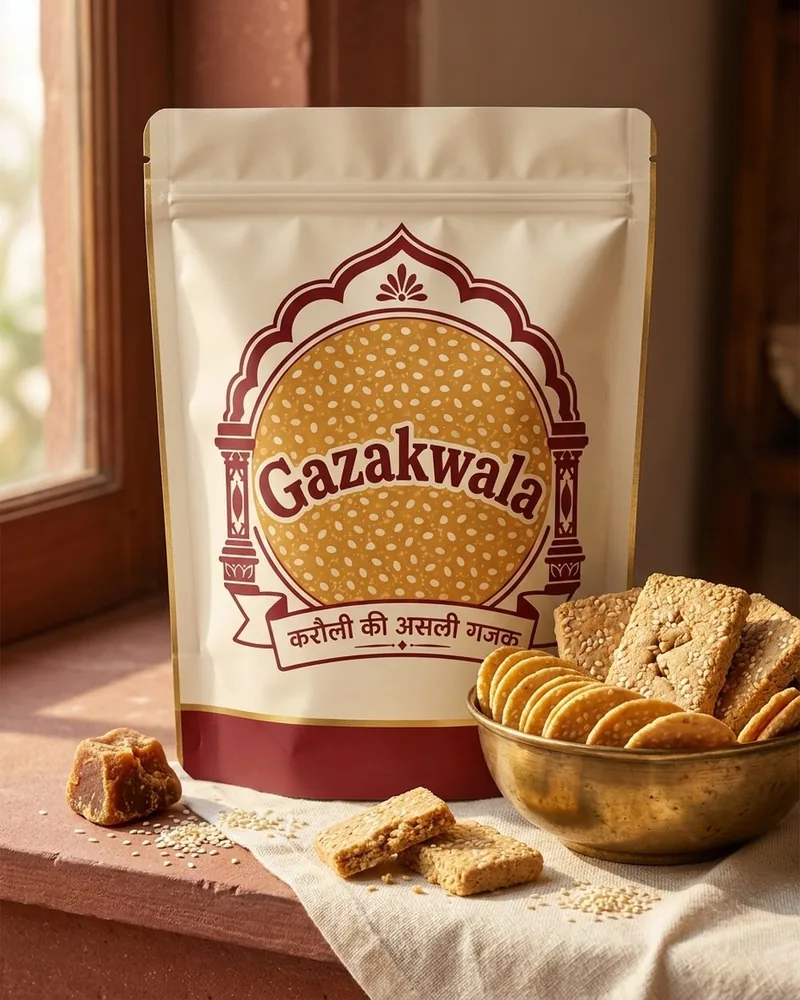
Karauli's signature is different in two ways. First, the tilpatti — the paper-thin disc of gajak, thin enough to read through, dense with roasted sesame. Second, the classic Karauli gud slab: heavier, chewier at the edges, more jaggery-forward, closer to what a Rajasthani grandmother would make at home in January. Neither style is objectively better; they are two regional expressions of the same idea.
How to choose
Once you set aside the tribal loyalty and look at what you actually want, the choice becomes simple.
Buy Morena gajak if you want the layered, aerated soan style, or the sugar-based versions Morena shops are particularly good at. The GI tag is a real assurance of origin if you are buying it labelled as Morena.
Buy Karauli gajak if you want the crisp, dense, jaggery-first style — and especially if you want tilpatti, which is Karauli's signature form. Buy it from a maker close to Karauli town and made in a licensed unit rather than a nameless roadside pack.
Why we spell it Gazak
We use the spelling 'Gazak' for two reasons. It is the spelling used in the Karauli ODOP listing and in Rajasthan state usage — the paperwork our region actually runs on. And it is the spelling that matches the way our elders write the word when they write it in English. We answer to gajak too; the sweet is the same.
Frequently asked
- Is gajak and gazak the same thing?
- Yes. They are two Roman spellings of the same Hindi word गजक. Gajak is the more common North Indian spelling; gazak is used in Rajasthan and in the Karauli ODOP listing. Both refer to the same til-gud sweet.
- Does Karauli gajak have a GI tag?
- No. Karauli holds ODOP (One District One Product) recognition for sesame and gazak, which is a government development designation. It is Morena gajak, from Madhya Pradesh, that holds the legal GI tag.
- Which is better, Karauli or Morena gajak?
- Neither is objectively better — they are different regional styles. Morena leans to the fluffier, layered soan style. Karauli's signature is the crisp paper-thin tilpatti and the dense jaggery slab. Choose by the style you want.
- What is the correct spelling — gajak or gazak?
- Both are correct. Gajak dominates in North Indian search and everyday usage. Gazak is the official Rajasthan and ODOP spelling. Gajjak is a third variant seen in parts of Bihar and Jharkhand.
संक्षेप में (हिंदी)
गजक, गज़क और गज्जक — तीनों नाम एक ही मिठाई के हैं। हिंदी शब्द गजक को अंग्रेज़ी में लिखने के कई तरीके हैं, इसलिए हर जगह अलग वर्तनी दिखती है। भारत सरकार की ODOP सूची में करौली जिले का उत्पाद 'तिल और गजक' है — यह पूरे देश की सूची में एक असामान्य और उल्लेखनीय बात है।
मुरैना की गजक को GI (Geographical Indication) टैग मिला हुआ है; करौली की गजक को GI नहीं, केवल ODOP मान्यता है। दोनों अलग-अलग चीज़ें हैं और दोनों को साफ-साफ बताना ज़रूरी है।
स्वाद के लिहाज़ से मुरैना की गजक हल्की और परतदार सोन शैली की होती है, जबकि करौली की पहचान कागज़ जितनी पतली तिलपट्टी और गुड़-प्रधान मोटी सिल है। कौन-सी बेहतर है — यह पसंद का सवाल है, गुणवत्ता का नहीं।
करौली की असली गजक — सीधे आपके घर तक
Order our winter batch on WhatsApp. Small-batch, no palm oil, no preservatives.
Order on WhatsApp