
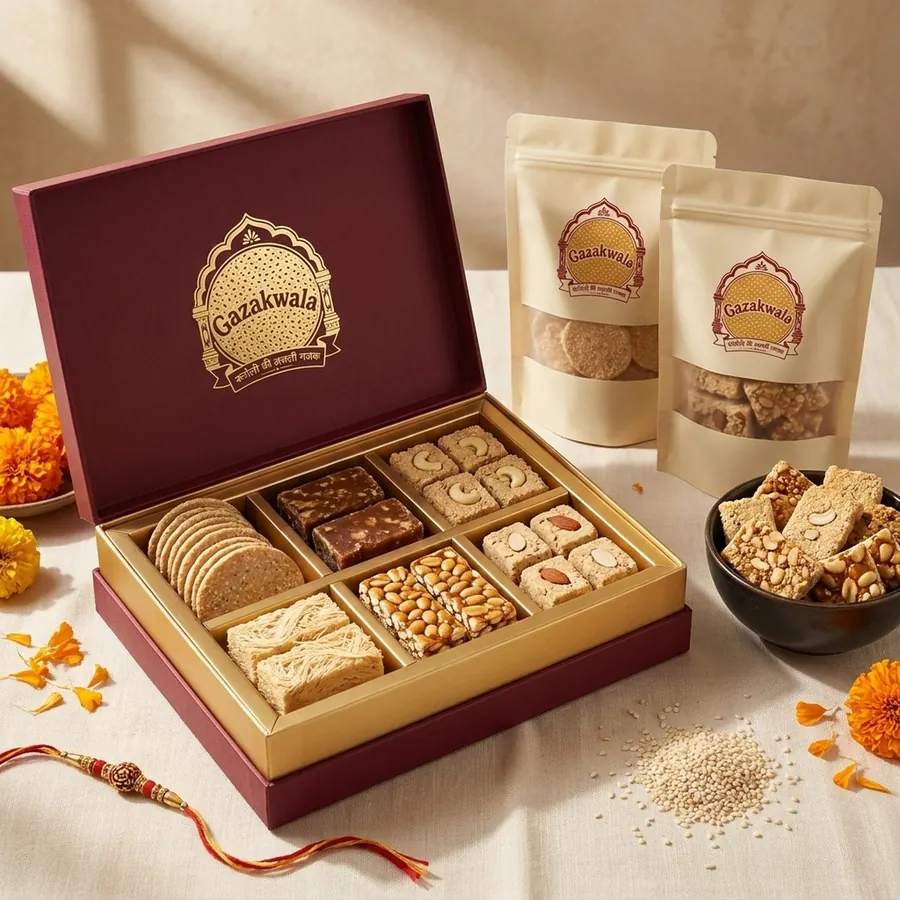
They all use sesame and jaggery. That is where the similarity ends. The technique is what makes each of them a different sweet.
The one-glance comparison
Before the explanations, here is what actually separates them on a counter.
| Gajak | Chikki | Tilpatti | Revdi | |
|---|---|---|---|---|
| Base | Sesame or peanut | Peanut, sesame or mixed | Sesame | Sesame |
| Jaggery state | Cooked to hard-crack, then beaten | Cooked to hard-crack, poured | Same as gajak, rolled thin | Cooked to hard-crack, small drops |
| Technique | Fold and hammer layers | Set flat and cut | Roll into thin disc | Drop and coat |
| Texture | Layered, crisp, brittle | Solid, glassy snap | Paper-thin, crisp | Small, hard, coated |
| Typical region | Rajasthan, MP, UP, Bihar | Pan-India | Rajasthan, MP | Punjab, UP, Delhi |
| Shelf life (sealed) | 3–4 weeks | 6–8 weeks | 2–3 weeks | 6–8 weeks |
| Best for | Gifting, festival platters | Everyday snacking | Delicate serving, guests | Loose sweet, Lohri throws |
The real technical difference is the beating
Chikki and gajak start life the same way. Jaggery — or in some versions sugar — is melted and cooked to what confectioners call the hard-crack stage, the point at which a drop plunged into cold water shatters cleanly. Roasted seeds or nuts are folded in. So far, identical.
The difference is what happens next. For chikki, the hot mass is poured onto a greased slab or tray, rolled flat, and cut into rectangles as it sets. It cools into a single dense sheet with the snap of hard toffee. That is chikki.
For gajak, the karigar does something else entirely. The mass is tipped onto a cold stone slab and, while it is still pliable, beaten and folded — repeatedly, with wooden mallets — the way a baker folds pastry. Each fold traps a thin layer of air and jaggery between layers of seed. After a few minutes of skilled beating, the mass is a laminated slab with dozens of visible layers. That is why gajak breaks with a shatter and a slight give, and chikki breaks with a clean glassy snap. The beating is the whole distinction.
Tilpatti is a form of gajak, not a separate sweet
This one confuses buyers all the time. Tilpatti is not a different confection from gajak. It is the same laminated til-gud mass, but instead of being finished as a thick slab, it is rolled while still warm into a disc so thin you can almost read through it.
Every tilpatti is a gajak. Not every gazak is a tilpatti. If a seller offers you 'gajak and tilpatti' as two different products, what they are really telling you is that they make the same sweet in two thicknesses — the slab and the disc. Both are worth having in a good box, because they eat very differently.
Revdi — the third cousin
Revdi is the small, round, coated form. The technique is different again: jaggery syrup is cooked, and small droplets are formed and rolled in sesame or coated in a thin sugar shell as they cool. The result is bite-sized, very hard, and much longer-lasting than gajak. Revdi is the sweet that gets thrown into the Lohri bonfire and passed around in fistfuls afterwards. It is a loose, everyday sweet rather than a gifting piece.
Regional names for the same idea
The vocabulary changes as you move across the northern plains. In Bihar and Jharkhand, the layered til-jaggery sweet is called tilkut, and Gaya's tilkut has its own strong regional identity — closer in technique to gajak than to chikki, but drier and often less sweet. Across most of North India, the same category is gajak. In Rajasthan, particularly around Karauli, the specific thin-disc form is called tilpatti and the word is in daily use.
Underneath the different names, it is one family of sweets: sesame, jaggery, winter, a stone slab and a mallet.
The varieties you will see on a Karauli counter
Even within gajak, a good Karauli shop will show you six or seven different pieces. Til gajak is the classic, roasted sesame and pure jaggery. Gud gajak names the version made specifically with dark, mineral-heavy jaggery — heavier, chewier, more traditional. Khasta gajak is the airier, layered version, closer in feel to a soan slab. Chini gajak substitutes sugar for jaggery and comes out paler and sweeter, popular with children. Dry-fruit gajak adds cashews, almonds or pistachios into the fold. Khoya gajak folds in reduced milk solids for a softer, richer bite. Roll gajak is the tilpatti rolled up around a filling, often dry fruit.
Which to buy for what
For a festival gift box, a mix — gud gajak slab, tilpatti and a khasta or khoya piece — gives your recipient the range of textures the tradition is built on.
For everyday snacking with tea, chikki or a plain til gajak block is the honest, portable choice.
For a Sankranti or Lohri distribution — the loose sweet you hand around — revdi and small tilpatti wedges do the job the tradition intended.
For guests you want to impress, serve tilpatti. It looks like nothing and eats like a small miracle.
Frequently asked
- Is tilpatti the same as gajak?
- Tilpatti is a form of gajak. The same laminated til-jaggery mass is either finished as a thick slab (gajak) or rolled into a paper-thin disc (tilpatti). Every tilpatti is a gajak; not every gajak is a tilpatti.
- Is chikki just a modern gajak?
- No, they are technically different. Chikki is set flat from cooked jaggery syrup, which gives it a glassy snap. Gajak is beaten and folded repeatedly on a stone slab, which creates the layered texture. The beating step is the entire distinction.
- Which lasts the longest — gajak, chikki or revdi?
- Chikki and revdi have the longest sealed shelf life, typically 6–8 weeks, because they are denser and less exposed to air. Gajak and tilpatti are more layered and hygroscopic and are best eaten within 3–4 weeks of packing.
- What is tilkut and how is it different?
- Tilkut is the Bihar and Jharkhand version, particularly famous from Gaya. It is closer to gajak in technique — cooked jaggery beaten with sesame — but is usually drier and less overtly sweet than a Rajasthani gud gajak.
संक्षेप में (हिंदी)
गजक, चिक्की, तिलपट्टी, रेवड़ी और तिलकुट — ये सब एक ही परिवार की मिठाइयाँ हैं, पर हर एक अलग है। सबसे बड़ा अंतर बनाने की तकनीक में है, सामग्री में नहीं।
चिक्की गुड़ को सांचे में जमाकर बनाई जाती है, इसलिए एक सख्त, कांच जैसी परत बनती है। गजक में गरम गुड़-तिल के मिश्रण को पत्थर की सिल पर बार-बार पीटा और मोड़ा जाता है, जिससे कई पतली परतें बनती हैं — यही गजक की असली पहचान है।
तिलपट्टी अलग मिठाई नहीं है — वह गजक का ही कागज़ जितना पतला रूप है। रेवड़ी छोटी, गोल, तिल में लिपटी बूँदें हैं। बिहार-झारखंड में इसी तरह की मिठाई तिलकुट कहलाती है।
Read next
करौली की असली गजक — सीधे आपके घर तक
Order our winter batch on WhatsApp. Small-batch, no palm oil, no preservatives.
Order on WhatsApp