
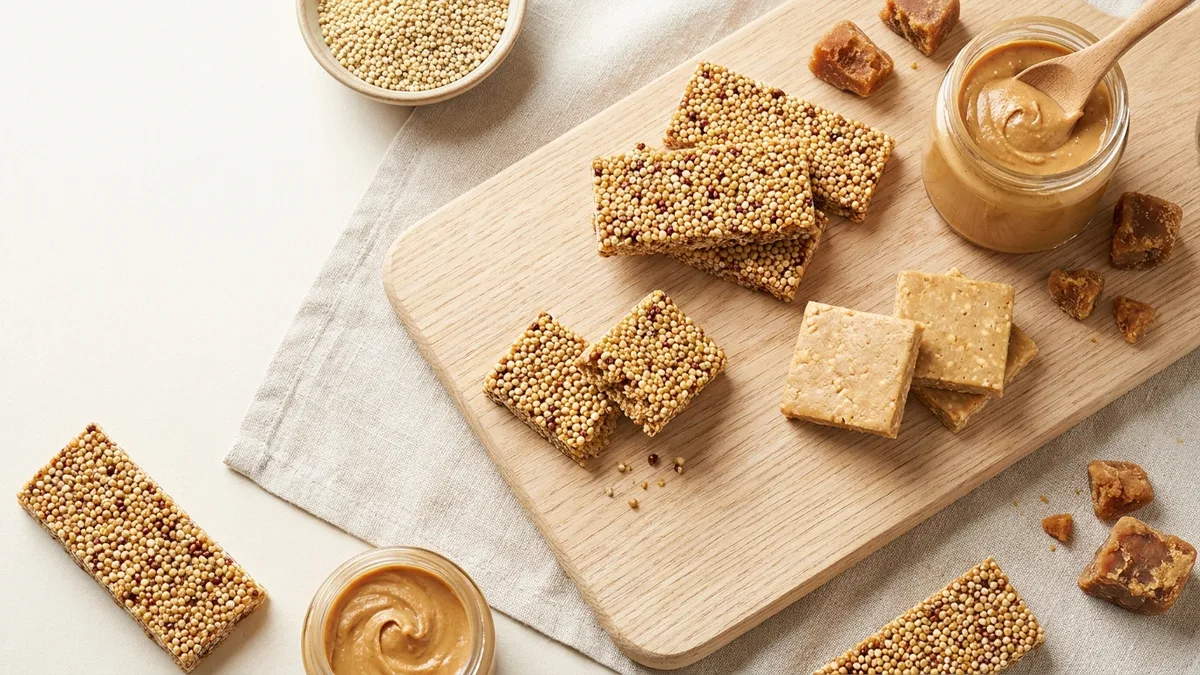
Bajra, ragi and ground peanut are reshaping a sweet that was already an energy bar. What genuinely changes, what does not, and how to read the pack.
Why chikki was already an energy bar
Before the category had a name and a wrapper, chikki was doing the job: nuts or seeds for fat and protein, a cooked sugar that binds them into a portable slab, low enough moisture to sit at room temperature for weeks without a preservative. Field workers, travellers and schoolchildren across India have carried it in exactly that role for generations.
So the modern variants are not inventing anything. What they are doing is adjusting the ratio and the base — swapping some of the nut for a puffed grain, or grinding the nut instead of leaving it whole — and that is a real change worth understanding, just a smaller one than the packaging usually suggests.
Millet chikki — bajra, ragi and jowar
Three grains dominate the millet chikki shelf, and they are not interchangeable. Bajra (pearl millet) puffs into a coarse, nutty grain with real chew and a mineral edge; it is the millet most people find immediately likeable in a sweet, and it carries iron. Ragi (finger millet) is finer and darker, with a distinctly earthy taste and a reputation built on its calcium content — it makes a denser, more serious-tasting bar. Jowar (sorghum) puffs light and mild, closer to popped corn in texture, and gives the airiest chikki of the three.
The technique genuinely differs from nut chikki. Puffed millet is a fraction of the weight of peanuts for the same volume, so a millet bar needs noticeably less jaggery by weight to bind it, and the syrup has to be worked in faster because there is less thermal mass to keep the mixture pliable. It sets in a fraction of the time a peanut slab takes.
It also goes soggy faster, and this catches people out. Puffed grain is porous by definition — that is what puffing does — and porous starch pulls in atmospheric moisture readily. A millet chikki left in an open bowl in a humid kitchen will lose its crispness in a day or two, where a peanut chikki would hold for a week.
Worth knowing on the demand side: India's millet push, culminating in the UN declaring 2023 the International Year of Millets at India's proposal, moved these grains from health-shop novelty to mainstream retail. Millet chikki is now a standard line rather than a curiosity.
Peanut butter chikki
Here the change is mechanical rather than botanical. Instead of whole or split peanuts suspended in jaggery, the peanut is ground — as butter or a coarse paste — and worked through the syrup. The result is a denser, more homogeneous bar with the fat distributed evenly rather than concentrated in discrete nuts.
Two consequences follow. First, texture: it is softer and it does not shatter, which is why it is popular with children and with anyone who has learned to be wary of traditional chikki's effect on a filling. Second, richness — the dispersed fat coats the palate differently and reads as more indulgent than the same weight of whole-nut chikki.
Makers also commonly pull the syrup slightly short of full hard-crack for this style, deliberately, to get a chewier bite that suits the smooth base. That is a choice, not a fault, and it is worth knowing if you buy one expecting a snap.
Do the healthier claims hold up?
Partly, and in a specific way. Millet chikki does bring more dietary fibre than a peanut chikki of the same weight, along with a different micronutrient profile — ragi for calcium, bajra for iron. Peanut butter chikki distributes its protein more evenly through the bar, which matters if you are eating a small piece rather than a whole one and want a predictable portion.
What does not change is the binder. Every one of these is still set in jaggery or sugar, in comparable proportion. So the calorie load and the sugar load of a millet chikki and a peanut chikki are in the same range, and swapping one for the other will not meaningfully change either number. The gain is in fibre and micronutrient quality, not in calories.
Treat 'healthy chikki' as a description of a better ingredient mix within a sweet, not as a licence to eat more of it. If you are managing blood sugar or weight, or you have a nut or sesame allergy, the same considerations apply here as to any other chikki, and a qualified professional is the right person to advise on your own situation.
Other modern variants worth knowing
Beyond millet and peanut butter, the category has quietly widened. These are the ones you will actually find on shelves and in D2C ranges.
- Rajgira chikki — puffed amaranth, the vrat-friendly one eaten during Navratri and other fasting days.
- Coconut chikki — desiccated or fresh-grated coconut in jaggery, softer and more fragrant, common in coastal states.
- Chocolate chikki — cocoa or a chocolate coating over a nut base, aimed squarely at children and gifting.
- Rose chikki — gulkand or rose essence folded through, usually with cashew or coconut.
- Sugar-free versions bound with date paste or fig instead of jaggery — softer, shorter shelf life, no snap.
- Roasted chana chikki — split roasted gram instead of nuts, cheaper and notably high in protein for its price.
What to look for on the pack
The word 'healthy' on the front of a chikki pack is unregulated. The ingredient list on the back is not. Read that instead, and check for these.
- Jaggery listed before sugar in the ingredients — order indicates proportion, so a bar that leads with sugar is a sugar bar with some gud in it.
- No glucose syrup or liquid glucose, which is used to cut cost and keep the bar soft.
- No palm oil — a well-made chikki needs no added fat beyond a little ghee.
- No artificial colour, particularly in the dark millet and chocolate variants where it is used to deepen the shade.
- A printed manufacturing date, not just a best-before — puffed grain bars stale much faster than nut bars.
- A clear allergen declaration covering peanuts, tree nuts and sesame, including cross-contact statements.
- A visible FSSAI licence number on the pack.
Frequently asked
- Is millet chikki healthier than peanut chikki?
- It brings more dietary fibre and a different micronutrient profile — calcium from ragi, iron from bajra. But both are bound in jaggery in similar proportion, so the calorie and sugar load is comparable. The improvement is in fibre and grain quality, not in energy content.
- Does millet chikki go soft faster?
- Yes. Puffed millet is porous, and porous starch absorbs atmospheric moisture much faster than dense roasted nuts do. A millet chikki can lose its crispness in a day or two in a humid kitchen, so keep it airtight from the moment you open the pack.
- Is peanut butter chikki good for kids?
- It is popular with children because the ground peanut base is softer and does not shatter like a whole-nut bar. It is still a sugar-bound sweet, so treat it as one. Children with a known peanut allergy should avoid it entirely — check the pack for cross-contact statements.
- What is sugar-free chikki made with?
- Usually date paste or fig paste as the binder in place of jaggery, sometimes with a sugar alcohol. These bars are softer, do not snap, and have a shorter shelf life because the moisture content is higher. They still carry the sugars naturally present in the fruit.
संक्षेप में (हिंदी)
चिक्की सदियों से वही काम कर रही है जो आज का एनर्जी बार करता है — मेवा, गुड़ और बिना परिरक्षक के लंबी शेल्फ लाइफ। मिलेट और पीनट बटर वाली चिक्की कोई नई खोज नहीं, बस अनुपात का बदलाव है।
बाजरा में लोहा, रागी में कैल्शियम और ज्वार में हल्कापन मिलता है। फूला हुआ अनाज हल्का होता है इसलिए गुड़ कम लगता है, चिक्की जल्दी जमती है — और नमी सोखकर जल्दी नरम भी पड़ जाती है।
फ़ायदा फाइबर और सूक्ष्म पोषक तत्वों में है, कैलोरी में नहीं — बंधन तो गुड़ ही है। पैक पर देखें: गुड़ पहले लिखा हो, ग्लूकोज़ सिरप या पाम ऑयल न हो, एलर्जी की जानकारी और FSSAI नंबर मौजूद हो।
करौली की असली गजक — सीधे आपके घर तक
Order our winter batch on WhatsApp. Small-batch, no palm oil, no preservatives.
Order on WhatsApp