
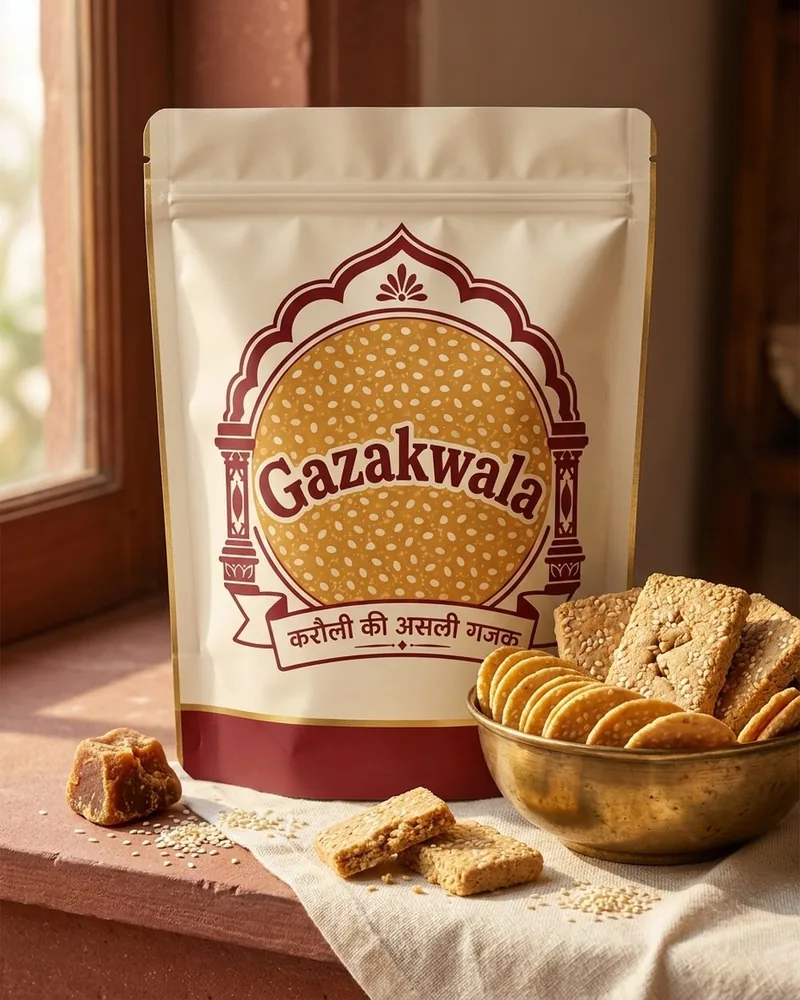
The gajak gift box is a January tradition with a strict calendar. Order too late and you get nothing; order the wrong box and you get powder. Here is how to do it properly.
Why til-gud is the festival's traditional gift
Makar Sankranti and Lohri are the two mid-January festivals that mark the sun's northward turn and the peak of the sugarcane and sesame harvest. Both festivals have, for generations, been built around one simple exchange: til and gud — sesame and jaggery — given to family, neighbours and colleagues.
In Maharashtra the phrase is 'til gud ghya, god god bola' — take this sesame and jaggery, and speak sweetly. In Punjab and North India the Lohri equivalent is quieter but the substance is the same: warmth given as food. The til-gud box is not a modern invention; it is the packaged form of a very old winter gesture.
What makes a good til-gud box
A good box gets three things right: assortment, texture range, and shelf life.
Assortment matters more than volume. A single flavour in a large box wears thin by the third piece; three or four varieties in the same weight is a better gift and a more traditional one. Try to include at least one gud-based slab (the classic), one tilpatti (the delicate showpiece), and one variation like khasta or dry-fruit that shows range.
Texture range keeps the box interesting. Combine a dense chewy piece with a crisp thin one. If everything in the box has the same bite, the recipient stops after two servings.
Shelf life is the practical one. Til-gud sweets are hygroscopic — they soften in humidity. A good box will state a manufacturing date, use sealed inner packing, and be honest about a 3–4 week eating window for gajak and tilpatti. Boxes marketed as lasting 'six months' either use preservatives or are overstating.
Box sizes by recipient
A rough guide that works for most gifting occasions.
| Recipient | Box size | Typical mix |
|---|---|---|
| A single household or elderly couple | 400–500 g | Two varieties, one gud one tilpatti |
| Extended family or in-laws | 800 g – 1 kg | Three to four varieties, assortment box |
| Office team of 8–12 people | 1.5–2 kg | Assortment box or individual mini packs |
| Client gift, one recipient | 500–750 g | Premium assortment, branded outer |
| Bulk corporate distribution | 150–250 g per person | Individual sealed mini packs |
The order calendar
Gajak is a winter-production sweet. Karigars make it roughly between October and January because the craft needs cool ambient air to keep the jaggery workable on the slab. Outside that window, quality drops and volumes shrink. This has real consequences for anyone gifting at Sankranti or Lohri.
Here is the calendar every gifting buyer should plan against.
| When | What to do |
|---|---|
| August – September | Corporate and large bulk buyers: confirm order in principle. Production capacity for January is being blocked. |
| October | Bulk orders confirmed with deposit. Custom-branded boxes signed off. Personal buyers can pre-book. |
| November | Season production is running. Personal orders open freely; corporate slots close. |
| Early December | Bulk corporate window essentially closed for January delivery. Personal orders comfortable. |
| Late December | Personal orders for Sankranti (14 Jan) and Lohri (13 Jan): place 10–14 days out. |
| First week of January | Cutoff for guaranteed pre-festival delivery. After this, shipping risk rises. |
| After 15 January | Post-festival trickle. Fresh production continues briefly, then winds down for the year. |
Shipping fragile sweets: why gajak breaks
Gajak is beautiful and brittle. It breaks for two reasons: because it is a laminated, thin structure, and because most sellers pack it as if it were biscuits. The failure modes are predictable — long slabs that flex and snap in transit, loose pieces that shuffle and grind each other into fragments, and inner trays with too much void space around them.
What good packing looks like: a rigid inner tray sized close to the piece, individual wrap for each slab, void-fill around the tray, and an outer carton stiff enough that a courier can drop it on a corner without deforming. Ask a seller how they pack for courier before you commit to a shipped gift; if the answer is vague, buy locally.
Corporate gifting: what changes
For company gifting the constraints are different — you are not buying one box, you are buying identical boxes at scale, with a lead time and often a custom branded sleeve. That work needs to start months earlier than a personal order.
See our bulk and corporate page for MOQ, lead times and custom-branding options. For fully custom hampers combining gajak with other festival pieces, our sister brand GiftingAdda handles the assembly work.
What to avoid
A short list, from years of watching what disappoints recipients.
- Heavily coloured gajak — traditional gajak is jaggery-brown or pale gold. Bright colours indicate additives.
- Palm-oil-based versions — they save the seller cost, cheapen the mouthfeel, and are not part of the tradition.
- Boxes with no manufacturing date on the pack — the whole point of a winter sweet is freshness.
- Very long shelf life claims — six-month gajak is either preserved or was never really crisp to begin with.
- Loose bulk cartons for shipping — they arrive as powder. Insist on individual inner wrapping.
Frequently asked
- When should I order Sankranti and Lohri gifts?
- For personal gifts, place your order 10–14 days before the festival — Sankranti falls on 14 January and Lohri on 13 January. For corporate bulk orders you need to confirm by late September to October; production capacity fills up early.
- How long does gajak stay fresh?
- Sealed and stored in a cool, dry place, good-quality gajak and tilpatti eat well for 3–4 weeks. They are hygroscopic and lose crispness in humidity, which is why we do not claim a longer shelf life.
- Can gajak be shipped without breaking?
- Yes, but only if it is packed properly — a rigid inner tray, individual wraps for each slab, void-fill around the tray, and a stiff outer carton. Loose bulk cartons arrive as fragments. Always ask a seller how they pack for courier.
- What is a good box size for a corporate gift?
- For one-to-one client gifts, 500–750 g of an assortment works well. For team distribution, individual sealed mini packs of 150–250 g per person are the practical format — they travel, they don't need cutting, and each recipient gets a fresh pack.
संक्षेप में (हिंदी)
मकर संक्रांति और लोहड़ी की परंपरा तिल-गुड़ की है — 'तिल गुड़ घ्या, गोड़ गोड़ बोला' का सीधा मतलब है, मीठा दो और मीठा बोलो। एक अच्छे गिफ्ट बॉक्स में एक जैसी चीज़ें भरने के बजाय तीन-चार अलग किस्में रखें: गुड़ की मोटी सिल, पतली तिलपट्टी और एक खस्ता या ड्राई-फ्रूट वाला टुकड़ा।
गजक सर्दियों की मिठाई है — कारीगर अक्टूबर से जनवरी तक ही अच्छी गजक बनाते हैं। कॉर्पोरेट ऑर्डर सितंबर–अक्टूबर में पक्के करने पड़ते हैं, और घर के ऑर्डर त्योहार से 10–14 दिन पहले।
गजक नाज़ुक होती है — सही पैकिंग (सख्त इनर ट्रे, हर टुकड़े पर अलग रैप, चारों तरफ फिलिंग) के बिना कूरियर में टूट जाती है। ज़्यादा रंगीन, पाम ऑयल वाली, या 'छह महीने ताज़ा' का दावा करने वाली गजक से बचें।
करौली की असली गजक — सीधे आपके घर तक
Order our winter batch on WhatsApp. Small-batch, no palm oil, no preservatives.
Order on WhatsApp