
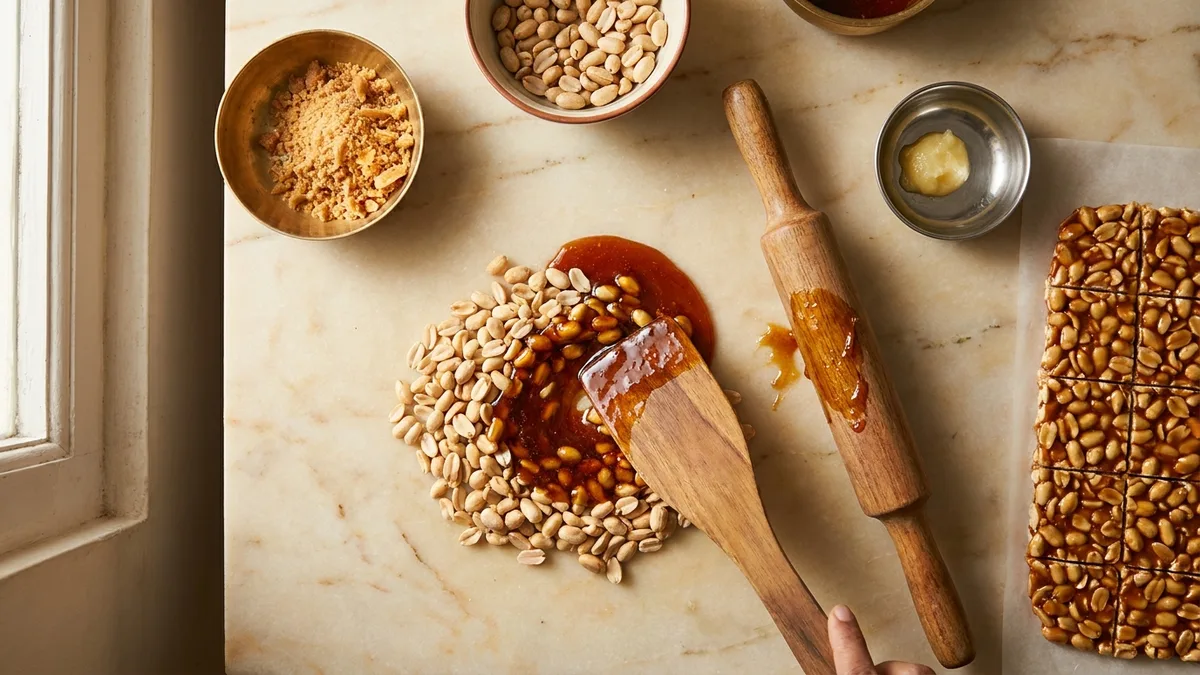
Two ingredients, fifteen minutes, and one temperature that decides whether you get brittle or toffee. Here is the peanut chikki recipe with the steps most versions leave out.
Ingredients and yield
Peanut chikki is a two-ingredient sweet with a third ingredient — heat — doing most of the work. Weigh rather than eyeball: the nut-to-jaggery ratio is what separates a bar that eats crunchy and nutty from one that eats like a sugar slab with a few peanuts trapped in it.
This ratio sits at roughly 1.1 parts peanut to 1 part jaggery, which is deliberately nut-heavy. Commercial chikki is often the reverse.
| Ingredient | Quantity | Note |
|---|---|---|
| Raw peanuts | 200 g | Roast and rub the skins off |
| Jaggery (gud) | 180 g | Pale, clean gud — grated or broken small |
| Water | 2 tbsp | Only to help the jaggery melt evenly |
| Ghee | 1 tsp | Plus extra for greasing the slab and pin |
| Cardamom powder | 1/4 tsp | Optional |
| Yield | ~350 g | About 16 pieces |
Roast the peanuts properly — this is where most chikki fails
Dry-roast the peanuts in a heavy pan on medium-low heat for 6–8 minutes, moving them constantly, until the skins blister, darken and start splitting. You are listening for a few of them to crack audibly. Take the pan off before they colour deeply — they carry on cooking in their own heat.
Cool them fully, then rub them between your palms or inside a clean kitchen cloth and winnow the loose skins away. This step gets skipped constantly and it is the single biggest reason homemade peanut chikki tastes harsh. Peanut skins are bitter, and because they are thin they scorch well before the nut does — so the burnt-edge bitterness people blame on the jaggery is usually the skins.
Then decide your style. Split the peanuts in half along their natural seam and the finished slab cuts cleanly into neat rectangles. Leave them whole and you get the rustic, hand-broken shard style with more crunch and a rougher cut.
Hard-crack stage decides everything
The whole recipe turns on one window: 149–154°C. Below it you have toffee. Above it the jaggery scorches and turns bitter. There is no rescuing either.
If you do not have a thermometer, use the cold-water test and learn what you are looking at. Keep a bowl of cold water next to the stove and drop a little syrup into it every 30–45 seconds as it cooks. Early on the drop dissolves into cloudy strands and feels sticky. Next it gathers into a soft ball you can flatten between your fingers. Then a firm ball that holds its shape. Then a hard ball that resists. Finally it sets into a brittle thread or sheet that shatters cleanly with a snap when you press it. That snap is hard-crack. Pull the pan off the heat at that exact moment.
One warning specific to jaggery: it browns far faster than refined sugar, and it is already dark to begin with. If you judge doneness by colour you will overshoot every time. Judge it by the water test or the thermometer, never by the shade of the syrup.
Step by step
Read the whole sequence before you start. Once the syrup hits hard-crack you have about 45 seconds of working time, and there is no pausing to find the rolling pin.
- Roast the peanuts 6–8 minutes on medium-low, cool, rub off the skins and winnow them away. Split or leave whole.
- Grease a flat slab, steel tray or marble surface and a rolling pin with ghee. Keep a greased knife within reach.
- Melt the jaggery with 2 tbsp water on low heat, stirring until fully liquid and no lumps remain.
- Raise to medium and cook to hard-crack stage — 149–154°C, or a droplet that shatters in cold water.
- Kill the heat. Stir in the peanuts, the teaspoon of ghee and the cardamom for about 15 seconds — just enough to coat everything.
- Pour the mass onto the greased slab in one go.
- Roll to 6–8 mm thickness fast, working from the centre outwards.
- Score into rectangles with the greased knife while the slab is still warm and pliable.
- Cool uncovered for 20 minutes — covering it traps steam and softens the surface.
- Snap along the score lines and store airtight immediately.
Why shengdana chikki, palli patti and groundnut chikki are the same recipe
Search results treat these as different sweets. They are one recipe wearing regional names. In Maharashtra it is shengdana chikki, from shengdana, the Marathi word for groundnut. In Andhra Pradesh and Telangana it is palli patti — palli for peanut, patti for the flat slab. Across North India it is mungfali chikki or simply groundnut chikki, and in Gujarat you will hear singdana chikki.
The differences between them are small and mostly textural. Maharashtrian shengdana chikki typically uses whole peanuts and is cut a little thicker, which gives that dense, jaw-working bite. Southern palli patti is often made with coarsely crushed peanut rather than whole, producing a sandier, more evenly packed slab that breaks more easily. North Indian versions sit between the two and lean slightly sweeter.
None of that changes the method. Same nut, same jaggery, same hard-crack window.
Five failure modes and the fix
Almost every batch that goes wrong goes wrong in one of five ways, and four of them are the syrup.
- Chewy instead of crisp — the syrup was pulled a few degrees short of hard-crack. Cook 15–20 seconds longer next time and re-test in cold water.
- Will not set at all — badly undercooked. It is not fixable once the peanuts are in, but it is perfectly good eaten as a soft peanut-gud fudge, spooned into a greased tray and cut cold.
- Bitter — either the skins were left in or the jaggery scorched past 155°C. Deskin properly and take the pan off the heat the moment the water test snaps.
- Cracks apart raggedly when cutting — the mass cooled before you scored it. Score earlier, and use a knife warmed under hot water and wiped dry, then greased.
- Soft after two days — moisture has got in. Store airtight, never near the stove, and refresh soft pieces on a tray in a 100°C oven for 4–5 minutes.
Storage
Airtight glass or steel, at room temperature, away from the kitchen steam. Homemade peanut chikki holds its snap for 8–10 days that way. Line the jar with parchment if you are stacking pieces, because warm shards fuse to each other.
Never refrigerate it. Every time you take the jar out, condensation forms on cold jaggery and the surface goes tacky within the hour. Cold is the one thing this sweet genuinely does not tolerate.
Frequently asked
- Why is my peanut chikki chewy?
- The jaggery syrup did not reach hard-crack stage. Anything below about 149°C sets as toffee rather than brittle. Cook 15–20 seconds longer and test again in cold water — the droplet must shatter, not bend.
- Can I use sugar instead of jaggery?
- Yes, and it is easier for a first attempt because sugar syrup behaves more predictably and you can see the colour change. Use the same weight and the same hard-crack temperature. The result is paler, sweeter and without the mineral depth jaggery gives.
- Should I remove the peanut skins?
- Yes. The skins are bitter and, being thin, they scorch long before the nut is properly roasted. Left in, they give the finished chikki a harsh aftertaste that most people wrongly blame on the jaggery. Roast, cool, rub between your palms and winnow them away.
- How long does homemade peanut chikki last?
- Eight to ten days in an airtight glass or steel jar at room temperature. Do not refrigerate — condensation makes the surface tacky. If it softens, warm the pieces in a 100°C oven for 4–5 minutes to bring the snap back.
संक्षेप में (हिंदी)
मूंगफली चिक्की की पूरी कामयाबी एक ही चीज़ पर टिकी है — गुड़ की चाशनी का सही पकना। 149–154°C यानी हार्ड-क्रैक स्टेज। ठंडे पानी में गिरी बूँद अगर काँच की तरह टूटे, तो तुरंत आँच बंद कर दें।
मूंगफली को मध्यम-धीमी आँच पर 6–8 मिनट भूनें, ठंडा करके छिलके पूरी तरह हटा दें। छिलके कड़वे होते हैं और जल्दी जलते हैं — घर की चिक्की में कड़वाहट की सबसे बड़ी वजह यही है।
गुड़ तैयार होते ही मूंगफली मिलाएँ, घी लगी सिल पर पलटें, 6–8 मिमी पतला बेलें और गरम रहते ही चाकू से टुकड़े काट लें। एयरटाइट डिब्बे में रखें — फ्रिज में कभी नहीं।
Read next
करौली की असली गजक — सीधे आपके घर तक
Order our winter batch on WhatsApp. Small-batch, no palm oil, no preservatives.
Order on WhatsApp