
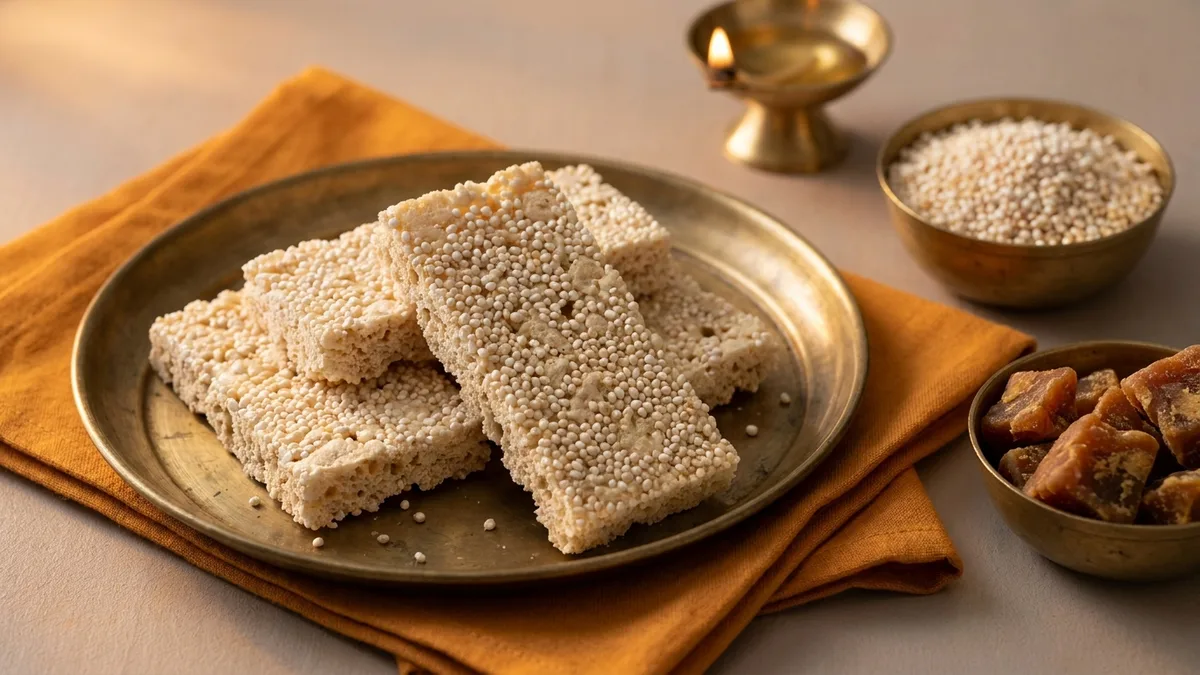
Amaranth is not a cereal, and that botanical fact is why rajgira chikki turns up on fasting plates when nothing else in the chikki family does.
What rajgira actually is
Rajgira is amaranth — and amaranth is not a grain. Botanically it is a pseudo-cereal: a seed from a broad-leaved plant that behaves like a grain in the kitchen but belongs to a completely different plant family from wheat, rice, barley and the true cereals, which are all grasses. Buckwheat (kuttu) and water chestnut flour (singhara) occupy the same category.
That distinction is the whole reason rajgira appears on a fasting plate. Vrat practice across much of India sets aside cereals and pulses for the duration of the fast, and because amaranth is not a cereal it has traditionally been permitted alongside kuttu, singhara, sabudana and sendha namak. It is a botanical line drawn by long custom, not a nutritional one.
You will meet the same seed under different names. Rajgira is the common Marathi and Gujarati name; ramdana — literally 'god's grain' — is what it is called across much of North India; chaulai refers to the leafy form of the same plant. All one thing.
Why rajgira chikki behaves differently
Puffed amaranth is astonishingly light. The seeds are tiny to begin with, and puffing expands them into hollow, porous specks, so a rajgira bar weighs a fraction of what a peanut bar of identical dimensions weighs. Pick both up and the difference is immediate.
That lightness changes how it is made. There is very little thermal mass in the puffed amaranth, so the jaggery starts setting the moment the two meet — the maker has seconds, not the half-minute a peanut slab allows, to spread and cut. It also means far less jaggery is needed by weight, which is why rajgira chikki tastes less aggressively sweet than most of the family despite being bound the same way.
The trade-off is humidity. Porous puffed seed pulls in atmospheric moisture faster than any other base in the chikki family, and once it does the bar goes from crisp to yielding very quickly. Rajgira chikki is the least dense chikki you will eat and the one most likely to disappoint you if it has been sitting open in a Mumbai or Kolkata kitchen.
Rajgira vs rajgira peanut chikki
Two products share the shelf and they are not the same thing. Pure rajgira chikki is puffed amaranth and jaggery, nothing else — light, airy, faintly nutty, and gone in two bites. Rajgira peanut chikki adds groundnut, which gives the bar substance, more protein and fat, and a longer, more satisfying chew. Many people prefer the peanut version simply because the pure one eats so quickly.
There is an important vrat caveat here. Peanuts are permitted during fasting in most traditions and are a fasting staple in Maharashtra and Gujarat in particular, where sabudana khichdi with peanuts is standard vrat food. But observance genuinely varies by family, community and region, and some households exclude them.
So if you or the person you are buying for fasts strictly, read the ingredient list rather than assuming the word rajgira on the front settles it. The two products look near-identical in a pack.
When it is eaten
Navratri is the big one, and it comes twice a year: Chaitra Navratri around March–April, and Sharad Navratri around September–October. Both run nine days, and rajgira chikki is one of the few sweets that fits the whole stretch without breaking the fast.
Beyond that it turns up on Ekadashi, observed twice each lunar month, on Janmashtami, on Mahashivratri, and on the regional and personal vrat days that fill out the calendar. For a lot of households it is simply the default fasting sweet, kept in a jar for whenever it is needed.
Sharad Navratri in September–October is when demand spikes hardest, since it is the longer-observed of the two and sits at the start of the festival season. If you are buying for a family or stocking as a retailer, that is the window to plan around — and it is also when freshly made stock is easiest to find.
What to check before buying vrat chikki
A pack labelled vrat or farali is making a claim about what is in it, and the label is the only place you can verify that claim. Check these before buying.
- The full ingredient list, read against the cereals and pulses your own practice sets aside — do not rely on the front-of-pack wording.
- No added glucose syrup or liquid glucose, which is a cost-cutting binder and not part of any traditional vrat recipe.
- Sendha namak (rock salt) rather than table salt, if salt appears at all.
- Whether the same unit also runs cereal-based lines — shared equipment means cross-contact, which matters a great deal to strict observers and is worth asking about directly.
- A printed manufacturing date, not just a best-before, because puffed amaranth stales considerably faster than nut-based chikki.
- A visible FSSAI licence number on the pack.
Storing rajgira chikki
Airtight, immediately, and mean it. Transfer it out of any pack that does not reseal properly the moment you open it, into glass or steel, and keep the jar away from the stove and the sink where kitchen steam collects.
Eat it within about two weeks for the texture it is supposed to have. It will still be safe well beyond that if stored properly, but the crispness that makes it worth eating fades first. Of everything in the chikki family, this is the one that punishes a loosely closed lid.
Frequently asked
- Is rajgira chikki allowed during Navratri fasting?
- Traditionally yes. Rajgira is amaranth, a pseudo-cereal rather than a true cereal grain, which is why it has long been permitted during vrat alongside kuttu, singhara and sabudana. That said, fasting practice varies by family, community and region, so check the full ingredient list against your own observance.
- Is rajgira the same as ramdana?
- Yes — the same seed under different regional names. Rajgira is the common Marathi and Gujarati term, ramdana the North Indian one, and both refer to amaranth. Chaulai is the leafy form of the same plant.
- Can you eat peanut chikki during vrat?
- Peanuts are permitted in most fasting traditions and are a vrat staple in Maharashtra and Gujarat. But some households exclude them, and a standard peanut chikki may not be made to vrat conditions in other respects. If you fast strictly, buy a bar labelled for vrat and read the ingredients.
- Why does rajgira chikki go soft so quickly?
- Puffed amaranth is hollow and porous, so it absorbs atmospheric moisture much faster than dense roasted nuts. In a humid kitchen an open bar can soften within a day. Store it airtight in glass or steel away from steam, and eat it within about two weeks.
संक्षेप में (हिंदी)
राजगिरा यानी रामदाना असल में अनाज नहीं, छद्म-अनाज (pseudo-cereal) है। यही वजह है कि व्रत में जब गेहूँ-चावल वर्जित होते हैं, तब भी राजगिरा की चिक्की परंपरागत रूप से चलती है।
फूला हुआ राजगिरा बेहद हल्का और छिद्रयुक्त होता है — इसलिए गुड़ कम लगता है, चिक्की तुरंत जम जाती है, और नमी लगते ही सबसे जल्दी नरम पड़ जाती है।
शुद्ध राजगिरा चिक्की में सिर्फ़ राजगिरा और गुड़ होता है; मूंगफली वाली में ज़्यादा प्रोटीन और भारीपन आता है। मूंगफली अधिकतर परंपराओं में व्रत में चलती है, पर हर परिवार की परंपरा अलग है — पैक पर सामग्री ज़रूर पढ़ें।
करौली की असली गजक — सीधे आपके घर तक
Order our winter batch on WhatsApp. Small-batch, no palm oil, no preservatives.
Order on WhatsApp