
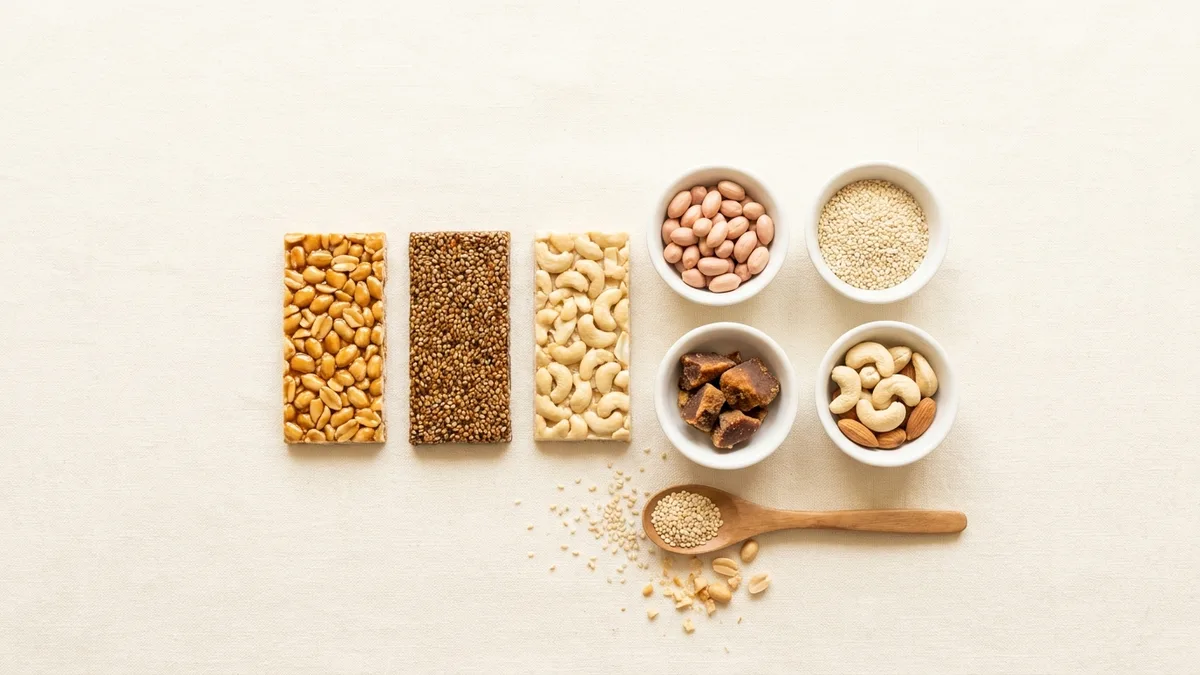
Per-100 g numbers make chikki look alarming. Per piece, it is an ordinary snack. Here is the honest breakdown by type, including protein, and where jaggery genuinely helps and where it does not.
The number people actually want: calories per piece
Almost every chikki nutrition figure online is quoted per 100 grams, which is a useless unit for this sweet. Nobody sits down to 100 g of chikki — that is four or five decent pieces. The per-100 g number reads like a meal and makes a snack sound reckless.
A normal piece of peanut chikki weighs 20–25 g. That lands at roughly 95–120 kcal, which is in the same territory as a banana with a spoon of peanut butter, or two plain biscuits. The table below gives both figures so you can use whichever is honest for what you are actually eating.
- These are typical indicative ranges for traditionally made chikki, given for general guidance. Actual values vary with recipe, jaggery grade and nut ratio — always check the nutrition panel on the pack you buy.
| Type | Approx kcal / 100 g | Approx kcal per 25 g piece |
|---|---|---|
| Peanut chikki | 450–480 | 115–120 |
| Til chikki | 470–500 | 120–125 |
| Kaju chikki | 470–500 | 120–125 |
| Badam chikki | 480–520 | 120–130 |
| Dry fruit chikki | 470–510 | 120–128 |
| Plain gud chikki | 380–400 | 95–100 |
Where the calories come from
Split a chikki's energy roughly in half. About half comes from fat in the nut or seed, and about half from the sugars in the jaggery. That split is why the numbers across types are so close together despite very different ingredients — you are trading nut fat against jaggery sugar in either direction.
Push the ratio towards more nuts and the total calories per 100 g go up, because fat carries more than twice the energy per gram that sugar does. But that same bar carries more protein, more fat-soluble micronutrients and a lower proportion of sugar. Push the ratio the other way and you get a cheaper, sweeter bar with fewer calories per 100 g and considerably less to show for them.
Plain gud chikki — jaggery set with very little nut, sometimes only a scatter of sesame — is the lowest-calorie member of the family for exactly this reason. There is almost no nut fat in it. It is also the least nutritionally interesting, because what is left is essentially sugar.
These are typical indicative ranges for traditionally made chikki, given for general guidance. Actual values vary with recipe, jaggery grade and nut ratio — always check the nutrition panel on the pack you buy.
Protein — the part chikki is quietly good at
This is the figure nobody quotes and it is the most flattering one. Peanuts carry roughly 25 g of protein per 100 g of nut; sesame seeds around 17 g. A genuinely nut-heavy chikki, where the nut is more than half the finished weight, therefore lands somewhere around 8–12 g of protein per 100 g.
Put that next to a commercial cereal bar and the comparison is not embarrassing. Many mainstream cereal and granola bars sit in a similar protein band, and they get there with a longer ingredient list — glucose syrup, maltodextrin, invert sugar, humectants, sometimes isolated soy or whey protein added specifically so the wrapper can carry a number.
Chikki gets its protein from whole roasted nuts and nothing else. That is not a health claim, it is an ingredient-list observation, and it is the strongest honest thing you can say about the category.
These are typical indicative ranges for traditionally made chikki, given for general guidance. Actual values vary with recipe, jaggery grade and nut ratio — always check the nutrition panel on the pack you buy.
What jaggery adds that refined sugar does not
Jaggery is cane juice boiled down without the refining and centrifuging steps that produce white sugar. Because those steps are skipped, gud retains a share of the molasses fraction, and with it iron, magnesium, potassium and assorted trace minerals that refined sugar has had stripped out entirely. That is a real, measurable difference in composition.
Now the honest half. The quantities involved are small. In a 25 g piece of chikki you are eating perhaps 10–12 g of jaggery, and the mineral content of that much gud is a minor contribution against a normal day's intake — not a meaningful source of anything on its own. And metabolically, jaggery is still sugar: it raises blood glucose in broadly the same way refined sugar does, and it should be counted the same way.
So the correct framing is narrow and defensible. Jaggery is a better sugar than white sugar — better flavour, an unrefined mineral fraction, a traditional process. It does not make a sugar-bound sweet into a health food, and anyone selling it that way is overreaching.
These are typical indicative ranges for traditionally made chikki, given for general guidance. Actual values vary with recipe, jaggery grade and nut ratio — always check the nutrition panel on the pack you buy.
Chikki vs a packaged energy bar
The packaged energy bar is a modern reconstruction of something chikki already was: nuts, a sugar that binds them, shelf stability without refrigeration, portable energy. The differences are in how each one gets there.
- These are typical indicative ranges for traditionally made chikki, given for general guidance. Actual values vary with recipe, jaggery grade and nut ratio — always check the nutrition panel on the pack you buy.
| Traditional chikki | Typical packaged energy bar | |
|---|---|---|
| Ingredient count | 2–4 | 10–25 |
| Sweetener | Jaggery (or sugar) | Glucose syrup, invert sugar, maltodextrin, sometimes dates |
| Protein source | Whole roasted nuts and seeds | Nuts plus added soy, whey or pea protein isolate |
| Preservatives | None — the low moisture does the work | Often humectants, emulsifiers, antioxidants |
| Approx price per 100 g | Lower for peanut, higher for kaju and badam | Usually higher for equivalent weight |
Who should be careful
Chikki is calorie-dense and sugar-based. That is not a criticism, it is the design — it exists to deliver a lot of energy in a small, shelf-stable piece. But it does mean it is not a snack to eat absent-mindedly from an open jar.
If you are managing blood sugar, following a weight-loss plan, or eating to a specific medical or dietary programme, treat chikki as the concentrated sweet it is and fit it in deliberately rather than casually. We are not in a position to advise on any individual's situation — a qualified doctor or registered dietitian is.
On allergens, be specific. Peanut, tree nuts such as cashew, almond and pistachio, and sesame are all present across this category, and sesame is a declarable allergen in India and most major markets. Anyone with a peanut, tree-nut or sesame allergy should read the pack rather than the product name, since dry fruit and mixed chikki often contain several at once and shared equipment is common in traditional units.
Frequently asked
- How many calories are in one piece of peanut chikki?
- A typical 20–25 g piece carries roughly 95–120 kcal. Peanut chikki sits around 450–480 kcal per 100 g, but per-100 g figures overstate a normal serving. These are indicative ranges — check the pack's nutrition panel for the product you buy.
- Is chikki good for weight loss?
- Chikki is energy-dense and sugar-bound, so it is not a weight-loss food. Where it can help is as a portion-controlled swap for more processed sweets, since a single piece is a defined amount with a short ingredient list. This is general information, not dietary advice — speak to a qualified professional about your own plan.
- Is chikki healthier than chocolate?
- It depends on what you compare it to. Against a filled or milk chocolate bar, chikki generally has fewer ingredients, no added fats beyond the nut's own, and no emulsifiers or preservatives. On calories and sugar the two are broadly comparable, so the advantage is in ingredient simplicity rather than in being a lighter option.
- How much protein is in chikki?
- A nut-heavy peanut or til chikki typically lands around 8–12 g of protein per 100 g, which works out to roughly 2–3 g in a single 25 g piece. Peanuts carry about 25 g protein per 100 g and sesame about 17 g, so the nut-to-jaggery ratio decides the figure.
संक्षेप में (हिंदी)
चिक्की की कैलोरी अक्सर प्रति 100 ग्राम बताई जाती है, जो भ्रामक है — कोई एक बार में 100 ग्राम चिक्की नहीं खाता। 20–25 ग्राम के एक टुकड़े में लगभग 95–120 कैलोरी होती हैं।
लगभग आधी कैलोरी मेवे या तिल की चर्बी से और आधी गुड़ की शक्कर से आती है। मूंगफली और तिल वाली चिक्की में प्रोटीन भी ठीक-ठाक होता है — करीब 8–12 ग्राम प्रति 100 ग्राम।
गुड़ में लोहा, मैग्नीशियम और पोटैशियम बचे रहते हैं जो सफ़ेद चीनी में नहीं होते, पर मात्रा कम है और गुड़ अंततः शक्कर ही है। यह 'बेहतर मिठास' की बात है, 'हेल्थ फ़ूड' की नहीं। तिल और मेवों की एलर्जी वाले लोग पैक ज़रूर पढ़ें।
Read next
करौली की असली गजक — सीधे आपके घर तक
Order our winter batch on WhatsApp. Small-batch, no palm oil, no preservatives.
Order on WhatsApp